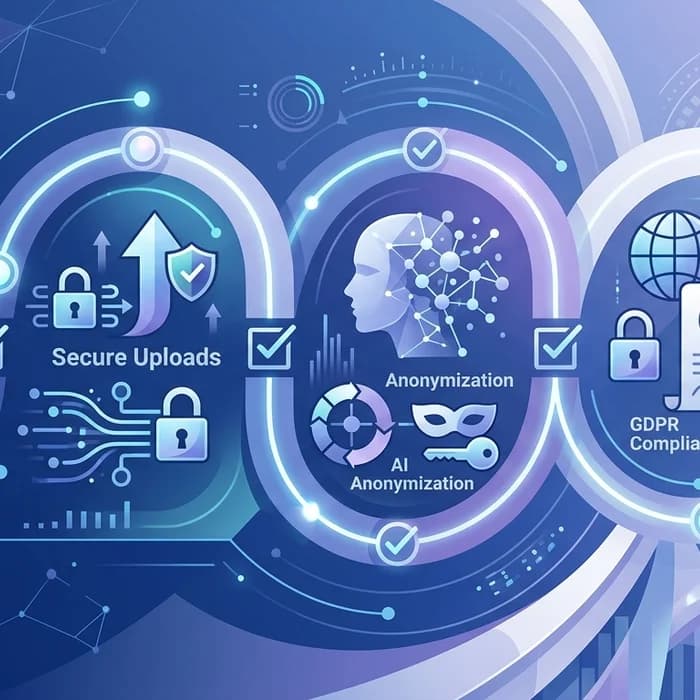
Secure Document Uploads: The 2025 Playbook for GDPR and NIS2 Compliance
From Brussels to boardrooms, one phrase has moved from niche IT jargon to a regulator’s litmus test: secure document uploads. In today’s Brussels briefing, officials reiterated that basic encryption isn’t enough when personal data moves through AI pipelines, vendor portals, or cloud readers. With NIS2 now in force across critical and important entities and GDPR enforcement intensifying, legal and security teams must treat every upload as a potential breach vector—and design controls that prove compliance end to end.

Why this matters now: enforcement, breaches, and political pressure
Two dynamics are colliding in 2025:
- Regulatory pressure is rising. DPAs are under the spotlight to act effectively and independently, and cross-border cases are moving faster. Expect more consistency reviews, more joint operations, and fewer delays.
- The threat landscape is noisier. This month, supply-chain incidents across developer ecosystems (npm, PyPI, RubyGems) were caught siphoning telemetry to rogue channels, and researchers detailed a modular campaign (“MonsterV2”) with data-theft payloads. These aren’t abstract threats—they target exactly the systems that touch uploaded files.
As a CISO at a European bank told me last week: “Uploads are the soft underbelly—you trust a vendor portal, a generative AI tool, or a plug-in, and suddenly your PDFs are a foothold into the crown jewels.” Average breach costs remain above €4 million, and GDPR fines can reach €20 million or 4% of global turnover—before we count civil claims and contract penalties. Under NIS2, critical and important entities face tight incident reporting clocks and executive accountability. The takeaway: secure document uploads aren’t a feature; they’re a governance pillar.
What “secure document uploads” mean under GDPR and NIS2
Under GDPR and NIS2, secure document uploads mean more than TLS. They require a lifecycle approach:
- Data minimisation and anonymization by design before files ever hit computing layers or third parties.
- Access controls, logging, and segregation of duties so uploaded files don’t bleed into unintended systems (e.g., analytics sandboxes or vendor support queues).
- Supply-chain hygiene: vetted dependencies, signed packages, and outbound traffic controls to stop “helpful” tools from exfiltrating metadata to chat servers.
- Auditability: evidence that uploads were scanned, redacted, and handled according to lawful purpose, with retention and deletion enforced.
Professionals avoid risk by using Cyrolo’s anonymizer at www.cyrolo.eu to strip identifiers before documents move into AI readers or vendor workflows.
Real-world risks in 2025: exfiltration, LLM drift, and silent shadow IT
- Supply-chain implants: Malicious or hijacked packages quietly send developer machine data and file metadata to messaging channels. If your upload service relies on such dependencies, you inherit the risk.
- LLM data drift: Default cloud AI tools may retain prompts and files for training or diagnostics. That’s a data transfer, often international, with transparency and consent obligations.
- Shadow uploads: Staff use consumer “PDF readers” or chatbots to summarize contracts or medical scans. Even if the content feels benign, embedded personal data turns a convenience into a reportable incident.
- Residual metadata: EXIF, DOCX revision history, or email headers can re-identify “redacted” files. Without robust anonymization and metadata scrubbing, you’re one pivot away from a privacy breach.

Build vs. buy: the secure upload pipeline decision
Teams often wonder whether to code an upload service in-house or procure a vetted platform:
- Build: full control, but ongoing burden—dependency vetting, cryptography maintenance, redaction quality assurance, breach simulations, DPIAs, and evidence packs for audits.
- Buy: faster hardening, documented controls, and tested anonymizers—provided your vendor offers EU data locality, no training on your files, and clear deletion guarantees.
For most organisations outside hyperscale tech, buying a specialized workflow with defensible controls is the quicker route to demonstrable compliance. Try our document uploads on www.cyrolo.eu—no sensitive data leaks, and a clear audit trail for legal and security reviews.
How an AI anonymizer fits into your secure document uploads workflow
Proper redaction is not just black boxes on a PDF. It’s detection of personal data, quasi-identifiers, and indirect identifiers across text, tables, and images, plus irreversible transformations. Here’s the model I recommend to CISOs and DPOs:
- Quarantine: New uploads land in a restricted bucket with malware scanning and content inspection.
- Automated detection: Recognise names, IBANs, national IDs, health codes, GPS, email, phone, and free-text PII.
- Irreversible transformations: Hashes, tokenization, masking, or generalisation, with context-aware rules to preserve analytic utility.
- Human-in-the-loop approval: High-risk items flagged for review with a diff view showing removed fields.
- Privacy-by-default routing: Only anonymized derivatives go to AI readers or external workflows.
- Key management and logs: Cryptographic keys segregated; append-only logs to prove every step.
In interviews, healthcare providers told me this flow cut breach exposure by orders of magnitude while preserving clinical research use. Legal teams gained a defensible DPIA narrative: necessity assessed, mitigations applied, residual risk documented.
GDPR vs NIS2: where secure uploads are scrutinised
| Area | GDPR | NIS2 |
|---|---|---|
| Scope | Personal data processing across all sectors | Cybersecurity risk management for “essential” and “important” entities |
| Key obligation for uploads | Lawful basis, data minimisation, integrity/confidentiality, data transfers | Technical/organisational measures, supply-chain security, vulnerability and patch management |
| Proof expected | DPIA, records of processing, vendor contracts, deletion logs | Policies, risk assessments, incident reports (24h/72h), audit trails |
| Penalties | Up to €20m or 4% global turnover | Substantial administrative fines and possible management liability |
| Third-country transfers | SCCs, adequacy, transfer impact assessments | Not transfer-specific, but expects secure architecture and threat-aware controls |
Compliance checklist: secure document uploads
- Map flows: Identify every upload channel—email gateways, vendor portals, AI tools, mobile apps.
- Classify and detect: Automated PII detection across formats (PDF, DOCX, JPG, CSV) with human review for high-risk cases.
- Apply anonymization: Use irreversible transformations and strip metadata by default.
- Constrain access: Role-based access, least privilege, short-lived links, geo-fencing, and IP allowlists.
- Secure the supply chain: Signed dependencies, SBOM, egress restrictions, and monitoring for unexpected callbacks.
- Encrypt and segregate: In transit and at rest, with separate keys and dedicated buckets for raw vs processed files.
- Evidence everything: Immutable logs, SOPs, DPIAs, and vendor due diligence records.
- Train and test: Staff training, phishing drills, tabletop exercises, and red-team tests for exfiltration paths.
- Deletion by default: Time-bounded retention with verifiable erasure.
EU vs US: cross-Atlantic realities
EU enforcement is rights-centric and documentation-heavy. US regimes are sectoral and state-led, with fast-evolving privacy acts and FTC action against deceptive security claims. Practically, EU companies must assume stricter transfer scrutiny and a higher bar for demonstrating necessity and proportionality when using AI. If you’re serving both markets, design for EU-level privacy-by-default and you’ll likely satisfy most US obligations with minor addenda.
Operationalising the program—fast
Here’s a pragmatic rollout I’ve seen work for banks, fintechs, hospitals, and law firms:
- Stand up a controlled upload front door that supports PDFs, DOC, DOCX, JPG/PNG, and spreadsheets.
- Embed automated anonymization and malware scanning as mandatory gates.
- Route only anonymized outputs to AI readers or external vendors; keep originals quarantined with strict access.
- Instrument logs and dashboards for DPO and CISO oversight; prepare a one-page evidence pack per workflow.
- Pilot with one use case (e.g., client onboarding or claims intake), then replicate the pattern.
Try our secure document uploads and AI anonymization at www.cyrolo.eu. Professionals avoid risk by using Cyrolo’s anonymizer at www.cyrolo.eu.
Important AI safety reminder
When uploading documents to LLMs like ChatGPT or others, never include confidential or sensitive data. The best practice is to use www.cyrolo.eu — a secure platform where PDF, DOC, JPG, and other files can be safely uploaded.

FAQs
What counts as “secure document uploads” under GDPR?
It’s a lifecycle, not just HTTPS. You need lawful basis, data minimisation, strong access controls, anonymization by default where possible, vendor safeguards, transfer mechanisms for non-EU processing, and verifiable deletion. Regulators will look for DPIAs and evidence that files didn’t leak into training sets, test systems, or support inboxes.
Is anonymization enough to take data outside GDPR?
Only if it’s truly irreversible and cannot be re-identified using “all means reasonably likely.” In practice, robust techniques plus metadata stripping and context tests are needed. Pseudonymization still falls under GDPR. Use defensible tools and keep documentation of techniques and residual risk.
How does NIS2 change my obligations for uploads?
NIS2 demands documented cybersecurity risk management, including supply-chain controls, incident reporting within tight timelines, and executive oversight. If uploads are part of a critical business process, expect auditors to ask for logs, SBOMs, egress restrictions, and evidence of detection and response for exfiltration attempts.
Can I safely upload contracts to ChatGPT or other AI tools?
Not if they contain sensitive or personal data. Many default settings allow retention and analysis. Use an isolated, compliant workflow with strict anonymization and data locality. The safest route is a dedicated platform. When in doubt, don’t upload. Use www.cyrolo.eu to keep uploads contained and auditable.
Do US-based providers create extra risk for EU files?
They can, due to international transfers and access by providers outside the EU. You need appropriate transfer tools and must assess surveillance risks. EU-hosted services with clear no-training policies and deletion guarantees reduce exposure.
Conclusion: make secure document uploads your default
In 2025, waiting for a breach to prove the point is no longer an option. Treat secure document uploads as a board-level control: anonymize early, log everything, and design out exfiltration paths. Then show your work to regulators. For a fast, defensible start, try Cyrolo’s anonymizer and secure upload workflow at www.cyrolo.eu—and remove “uploaded the wrong file to the wrong tool” from your incident register.
Sources & References
- 1Open letter: The EU must safeguard the independence of data protection authoritiesEDRi · 2025-10-14T07:38:26.000Z
- 2npm, PyPI, and RubyGems Packages Found Sending Developer Data to Discord ChannelsThe Hacker News · 2025-10-14T07:09:00.000Z
- 3Researchers Expose TA585’s MonsterV2 Malware Capabilities and Attack ChainThe Hacker News · 2025-10-14T05:28:00.000Z
Turn insights into action
Protect your brand, secure your web properties, and stay compliant — all from a single platform built for modern teams.
Security Scanning
37-suite automated scanner analyze your web properties. Get A+ to F security grading with actionable remediation steps.
Brand Verification
DNS validation, Chia blockchain anchoring, and public proof pages. Build trust with cryptographic evidence.
GDPR & Compliance
Article-by-article GDPR audits. Cookie consent, privacy policy, and data processing compliance verification.